
Celebrating Seven Years of Dance Grenada with Dr. Shola K. Roberts
Updated: 2 hours ago
Caribbean Excellence Builder of the Week: Dr. Shola K. Roberts opens the seventh Dance Grenada festival today, fresh off a national teaching award and a Spicemas season on the choreographer's stool.

Today, students from across the parish of St. David are gathering at Westerhall Secondary School for a community dance day, kicking off Dance Grenada 2026. Through workshops and conversations, they are being introduced to dance not only as a cultural expression, but also as a discipline, a career, and a pathway to opportunity.
The initiative reflects the vision of Dr. Shola K. Roberts, who founded Dance Grenada in 2020 to expand access to dance education, preserve Grenadian cultural heritage, and connect artists across borders. Now in its seventh year, the festival runs October 22–26, opening in Roberts’ home parish through a partnership with the Office of Creative Affairs, the Division of Culture, the Grenada Tourism Authority, and Westerhall Secondary School.

Following the workshop, a welcome cocktail will bring visiting artists and local cultural practitioners together to exchange ideas and build connections. From introducing young people to the possibilities of a career in dance to strengthening relationships among practitioners, the opening day sets the tone for Roberts’ broader mission: preserving Grenada’s cultural legacy while creating opportunities for the next generation to carry it forward.
This year's theme explains why it kept going: Demonstrating Purpose, Moving with Intention.
Building Access to Caribbean Dance
Dance Grenada emerged from Roberts' recognition of gaps in access to dance education, professional development, and the documentation of Caribbean dance forms.
While dance is a visible expression of Caribbean culture, the scholarship, training, and institutional support behind it do not always receive the same attention. Roberts wanted to create a space where dancers could learn from experienced practitioners, explore different movement traditions, engage in conversations about the art form, and understand dance as a viable professional pursuit.
The initiative combines dance classes, performances, panel discussions, cultural exchange, and educational opportunities. It also creates connections between artists based in Grenada and practitioners working throughout the diaspora.
For Roberts, these connections are essential to the development of the creative economy. Behind every performance are artists who have studied, trained, developed their craft, and invested years in their profession. Their work deserves to be supported and taken seriously.
"In a time where we are pushing the creative economy, we also have to hold the arts to its highest esteem," she says. "Knowing that there are individuals who are contributing to the creative economy, they had to study."
Dance Grenada, she believes, can help advance that recognition while contributing to cultural tourism and the preservation of Grenada's dance traditions.
The initiative has also evolved beyond its original programming. One example is its community dance day in St. David, Roberts' home parish, where students are introduced to the festival and encouraged to consider dance as a career.
Another is the festival's choreographic exchange, which connects dancers in Grenada with choreographers based in places such as New York, Ohio, and Arizona. Through these collaborations, artists can share work across geographic boundaries, broadening the range of experiences available to local dancers.
The timing matters. With US visa restrictions making some Caribbean companies hesitant to travel, the exchange offers another route.
"We are also finding diverse ways for us to still collaborate and create this work," Roberts says.
It is an approach that recognizes the Caribbean's creative strength as something that can be nurtured locally while benefiting from international relationships.

Preserving the Stories Behind the Movement
For Roberts, building the future of Caribbean dance also means safeguarding its past.
Her scholarly work has drawn attention to the lack of archival documentation surrounding Grenadian dance forms and the people who have dedicated their lives to keeping them alive. Too often, the histories of cultural practitioners remain known within their immediate communities but are not adequately documented for younger generations.
Dance Grenada has made honoring these pioneers part of its mission.
"I feel like at no point in time was anyone honoring or recognizing some of our artistic practitioners on the island until Dance Grenada started doing that," Roberts says.
Among the cultural figures Roberts recognizes as foundational to Grenadian dance is Dame Gloria Payne-Banfield, who established Vini Vwai La Grenade, one of the island's longstanding folk dance companies. She also points to practitioners such as Cecilia Griffith, Dr. Cheryl Barnabe-Bishop, and Keith Williams, whose knowledge and contributions help sustain the island's cultural traditions.
Roberts says she came to understand the importance of these stories through conversations with the people who lived them. Without taking the time to sit with these elders and learn from their experiences, she might never have fully understood their contributions or incorporated their histories into her own research.
"If I didn't sit at the foot of Miss Gloria, I wouldn't have known her story to even put it in my dissertation," she says.
That experience reinforced her commitment to creating spaces where cultural knowledge can be shared and preserved.
Her philosophy is rooted in Ubuntu, often expressed as "I am because we are." The principle recognizes that individual achievements are inseparable from the communities, teachers, and generations that make them possible.
"We don't exist without the elders whose shoulders we stand on," Roberts says, "and the younger generation who is depending on us to continue to create the pathway for them to thrive."
It is a philosophy that informs how she approaches her work: acknowledging the elders who paved the way while building opportunities for the young people who will carry the culture forward.
Dance, in this context, becomes more than performance. It becomes a living archive.

Turning Cultural Pride Into Opportunity
Roberts' approach to dance education is shaped by her own upbringing in Grenada.
She recalls being included in her parents' social gatherings, where she experienced soca and calypso not simply as music but as expressions of community, joy, movement, and connection. Those early experiences continue to influence how she teaches.
"I saw them party. I saw them engage in the soca and the calypso, and what joy looked like when they interacted with the music," she says. "How they moved their bodies, how they responded to the music, and how they spoke to each other."
In her classrooms, music and the ways people respond to it become tools for learning. She encourages dance educators to recognize the cultural knowledge embedded in everyday experiences and to use those connections to deepen students' understanding of movement.
That philosophy also informs Dance Grenada's programming, which encompasses Grenadian folk dance, Shango as practiced on the island, Mandingo traditions, Afro-Cuban dance, contemporary and modern forms, and other movement practices.
The festival brings these traditions into conversation while creating opportunities for dancers to learn from practitioners with different backgrounds and areas of expertise.
The practical outcomes matter, too.
Dance Grenada aims to award 15 full and partial scholarships each year, helping reduce financial barriers for students who want to participate in the festival. Roberts understands that talent and ambition alone do not guarantee access to training.
"Fundraising does take work," she says, "but there are entities out there that believe in this work, which then gives Dance Grenada the opportunity to support these young artists' dreams."
The initiative is also helping participants see what a future in dance might look like beyond the classroom or studio.
One scholarship recipient, Joshua Robertson, is studying dance at the University of Trinidad and Tobago (UTT). Roberts points to his experience as an example of how exposure, mentorship, and professional connections can open doors that young dancers may not have previously imagined.
"He would have been exposed to dance forms beyond his mind's eye in Grenada," she says, "knowing that there's so many other avenues out there and that you can actually study and train and get a degree in it."
For her, this is part of the return on investment in cultural development: creating pathways for young artists to train, build networks, and represent Grenada on a wider stage.
It mirrors her own career. "I didn't necessarily get all of my jobs through auditioning," she says. "It was through the community. It was through networks."
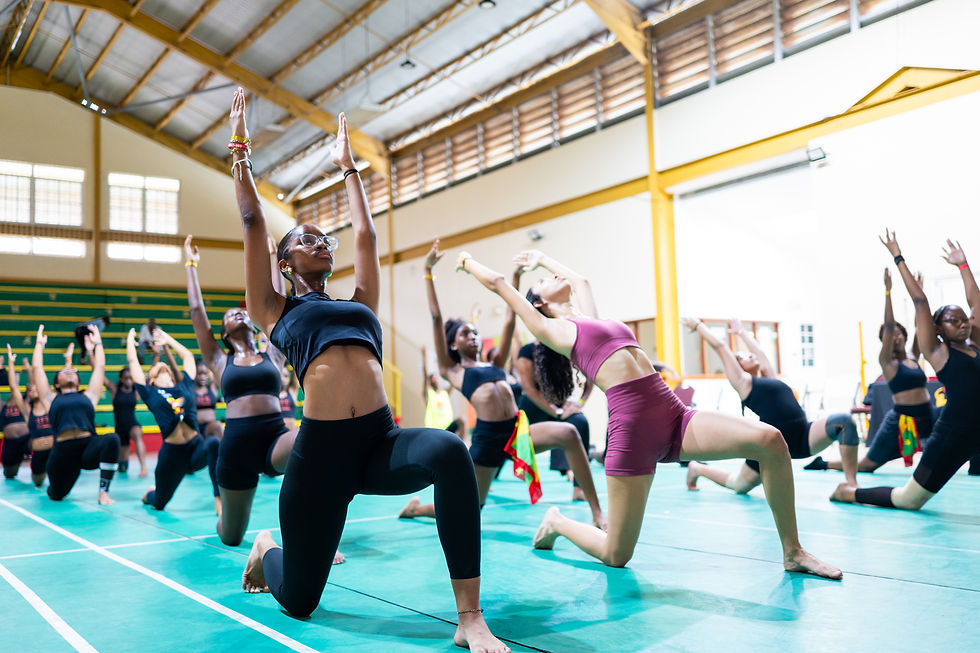
Demonstrating Purpose, Moving With Intention
Dance Grenada's seventh year carries the theme "Demonstrating Purpose, Moving With Intention."
The theme reflects Roberts' own experience of transition and growth. After dedicating seven years to teaching middle school, she relocated from New York to Arizona, bringing her experience into a different community while continuing to develop her work as an educator and cultural practitioner.
She sees the festival's seventh year as an opportunity to reflect on how the initiative has evolved, without suggesting that its mission is complete.
"Seven is often associated with this idea of fulfillment and completion," she says. "Not to say that Dance Grenada has fulfilled everything and we're complete, because we are far from finished."
For Roberts, intentionality means understanding why a program exists, why a particular educator is invited, and how each initiative contributes to a larger goal. It means creating with a clear sense of purpose rather than simply organizing activities for their own sake.
"We're not just doing this frivolously," she says. "There's always a justification as to why this event is in place, why this teacher is here, why we're starting this new initiative."
That commitment was tested when the festival began in 2020, amid the uncertainty of the COVID-19 pandemic. Roberts recalls feeling discouraged, until a friend encouraged her to find another way forward.
The advice was simple: pivot. She said, 'No, we're not going to not do this. You're just going to pivot. So figure it out and pivot,'" Roberts recalls.
She did, and Dance Grenada continued to develop, building relationships, expanding its programming, and finding new ways to bring artists together.
Today, its work reflects that willingness to adapt while remaining grounded in its mission.
The festival's 2026 programming includes a community dance day in St. David, the Moving with Intention concert, choreographic exchanges, dance classes, panel discussions, scholarship recognition, and a closing beach ceremony featuring a collective performance honoring those who have passed on.
"What better way to honor them than with the dance," Roberts says. Together, these activities demonstrate how dance can create space for education, remembrance, cultural exchange, and community building.

Building Beyond Borders
Roberts describes herself as a cultural practitioner, educator, and traditional torchbearer. Her work spans communities in Grenada and the United States, allowing her to bring international experience into local conversations while remaining connected to the culture that shaped her.
"I don't talk the talk because I haven't walked the walk," she says. "I am the lived archive of this work."
She is also clear that the work cannot be sustained by one person alone. Sponsors, cultural practitioners, educators, students, community members, and the people who came before all contribute to the larger vision.
"It belongs to my community," she says of the recognition her work has received. "It's for the young dancers in Grenada who are continuing to see people that look like them take up space."
For Caribbean communities, the lesson extends beyond dance. Cultural preservation requires active participation. Developing the creative economy requires investment in the people doing the work. And creating a future for the next generation means ensuring they have access to the knowledge, training, and networks that allow them to thrive.
Roberts' contribution is to bring those priorities together through a platform that values both heritage and possibility.
As Caribbean Excellence Mag continues to spotlight the people building the region and its diaspora, her story offers a compelling reminder that building the Caribbean does not always mean constructing something new. Sometimes, it means creating the conditions for what already exists to be recognized, documented, strengthened, and passed on.
Through Dance Grenada, Dr. Shola K. Roberts is doing precisely that: honoring the people who came before, opening doors for those here now, and helping the next generation imagine how far their talents can take them.
Follow Dance Grenada: dancegrenada.com
Caribbean Excellence Mag’s Builder of the Week celebrates the founders, innovators, cultural practitioners, and community leaders whose work is shaping the Caribbean and its global diaspora.



Comments